
G-MAQ Performance Example (Industrial Use)
代表的な G-MAQ 製品に関する性能例を、様々な角度からの試験データを通じてご確認いただけます。
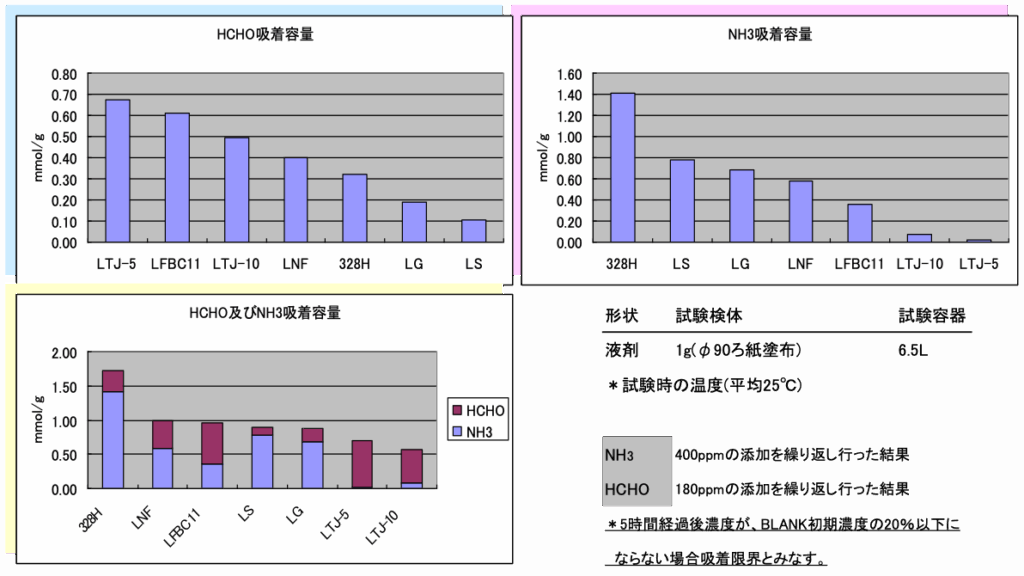
Sick House Countermeasure Actual Test Data - Liquid Agents
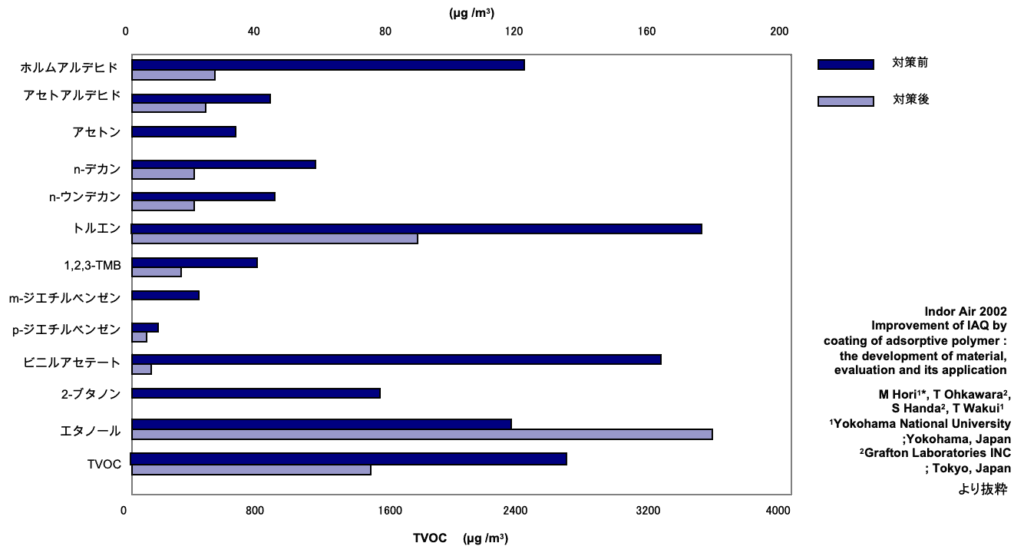
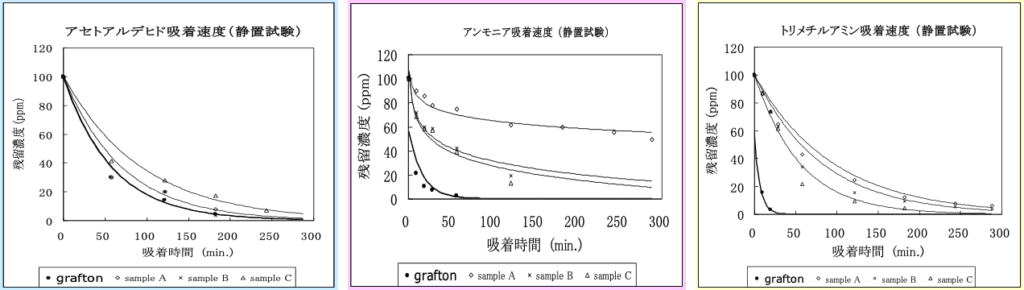
Deodorizing Performance Comparison Test Data ① Capacity - Pulp Pellet Type
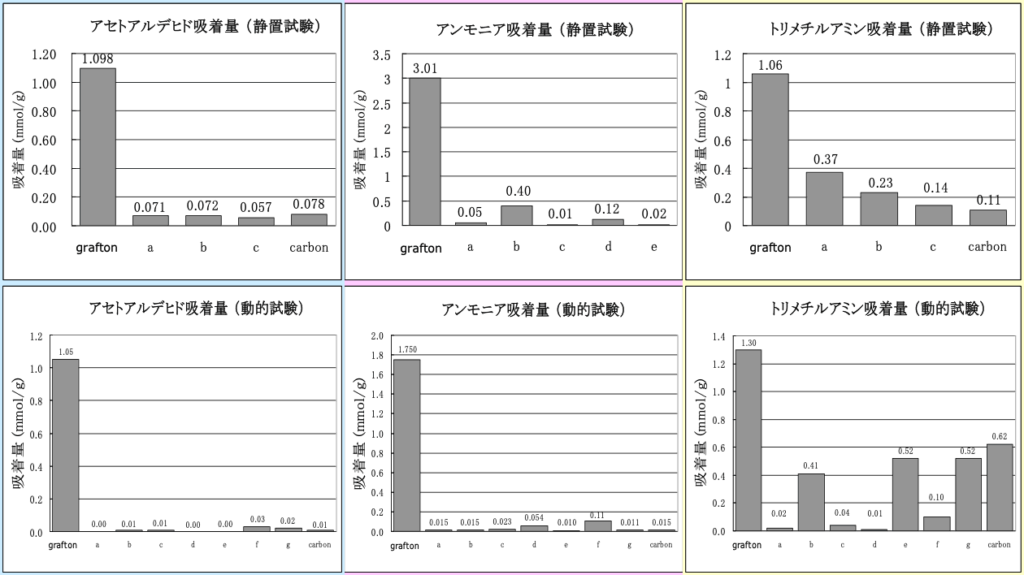
Deodorization Performance Comparison Test Data ② Speed / Pulp Pellet Type
Test method
There are no officially established testing methods for gases, especially foul-smelling ones, yet. Therefore, we conducted the tests in accordance with the measurement method published by the Faculty of Engineering, University of Tokyo, in the reprint of environmental technology issued by the Japan Environmental Technology Research Association.
The sample weight is 80g. The products from each company for the dynamic test were used as is, and the cumulative adsorption capacity was converted based on the sample weight.
A testing apparatus was constructed as a transparent rectangular box made of acrylic, with dimensions of 50cm width, 50cm depth, and 60cm height, giving an internal volume of 0.15 cubic meters. Sampling and gas injection taps were installed in the center, and a small fan for stirring was placed at the bottom.
The cumulative adsorption capacity was determined by first injecting the target gas into the test apparatus and adjusting the concentration to 100 ppm. The adsorption rate was measured by monitoring the concentration at elapsed time intervals. The adsorption amount was adjusted back to 100 ppm when the concentration decayed to 20 ppm after the start of the test, and this process was repeated. The test was terminated when the concentration no longer decayed to 20 ppm after 5 hours had passed. (All at 20°C)
Adsorption isotherm · Liquid agent
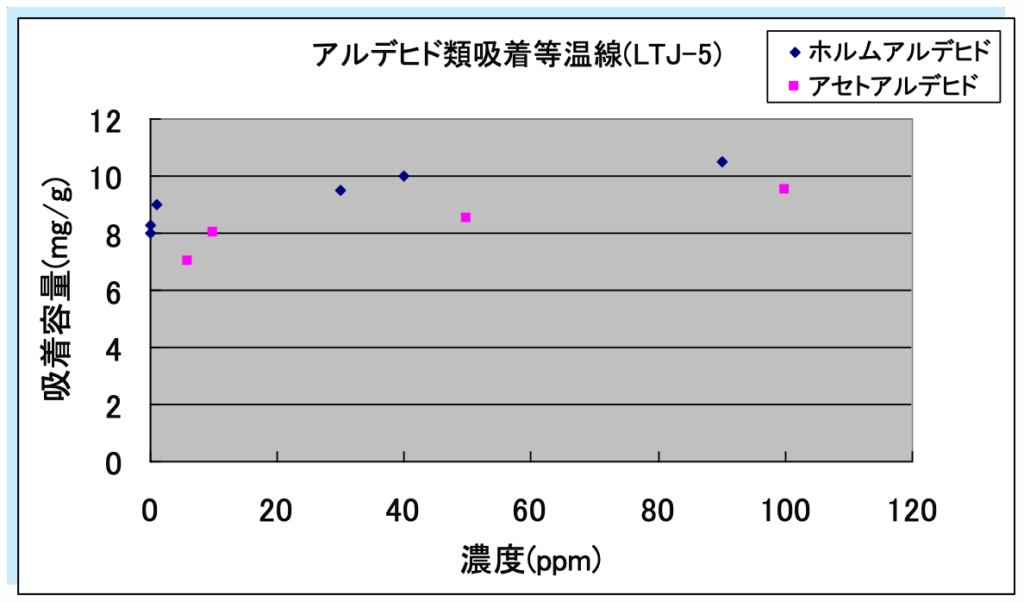
Adsorption and liquid agents for substances with different polarities
G-MAQ Performance Examples (For End Users / Business Use)
エンドユーザー様向け / 業務用の G-MAQ 製品に関する性能例については、下記のリンク先をご参照下さい。
As an example of performance, I will briefly introduce only G-MAQ antibacterial and deodorizing spray.
Comparison of deodorizing power with representative commercially available deodorizing sprays
- Ammonia: Approximately 3.4 times
(The most representative unpleasant odor-causing substances contained in body odor, urine odor, etc.) - Acetaldehyde: Approximately 35 times
(Typical odor-causing substances such as cigarette smoke) - Trimethylamine: Approximately 43 times
(Representative malodor-causing substances in spoiled meat and fish, and pet odors) - Formaldehyde: Approximately 50 times
(The most representative causative agent of sick house syndrome and a carcinogenic harmful chemical substance)
☆Other,Nonenal (a major malodorant substance such as aging odor)/Isovaleric acid (a representative foul-smelling causative agent of body odor and sweaty foot odor)Wait,Extremely effective against odors that conventional deodorizers have had trouble with.Is.
…Antibacterial activity value: 5.2 (Based on JIS L1902:2005, liquid shake method)